PROCUREMENT GUIDE
Aerial Fire Truck Selection: Turntable Ladder or Boom Platform?
Compare turntable ladders and boom platforms using real 32 m appliances, cage loads, working envelopes, support space and a practical quotation schedule.
Published
Choose the access system around the places your crew must reach, then compare the complete vehicle. A headline working height does not tell you whether the basket can reach a recessed window, carry the required rescue load or operate from the available setup area. For an aerial fire truck enquiry, specify the target height and horizontal offset together, the basket load, obstacles, support space and route limits.
A turntable ladder has an extending ladder set and may also carry a rescue cage or an articulated tip. A boom platform uses a boom-mounted work basket; some designs also have a rescue ladder. A basket alone therefore does not distinguish the two. Compare the actual access arrangement, load chart and rescue method rather than the sales name.
Two real 32 m appliances with different buying implications
Hereford & Worcester Fire and Rescue Service operates two Bronto F32RL aerial ladder platforms, stationed at Hereford and Worcester. They use Scania chassis, have a 32 m working height and a 325 kg cage working load. These are that service's appliances, not Chengli deliveries. Hereford & Worcester appliance details.
In September 2020, Ennepetal Fire Department in Germany received a Magirus M32L-AS on a Mercedes-Benz Atego 1630 F 4×2 chassis. That articulated ladder has a 32.0 m working height and an RC400 cage rated at 400 kg. Ennepetal delivery configuration.
| Comparison field | Hereford & Worcester F32RL | Ennepetal M32L-AS |
|---|---|---|
| Access arrangement | Articulated boom aerial ladder platform | Articulated extending ladder with cage |
| Working height | 32 m | 32.0 m |
| Cage working load | 325 kg | 400 kg |
| Overall length | 9,070 mm | 10,170 mm |
| Overall width | 2,550 mm | 2,500 mm |
| Overall height | 3,550 mm | 3,400 mm |
The same height class gives a 75 kg difference in cage rating and a 1,100 mm difference in vehicle length. The longer vehicle is also narrower and lower in this pair. That is a useful reason to compare each dimension separately; neither vehicle can be declared the better fit without the route, setup area and task-specific load chart. The figures describe those individual configurations, not every ladder or platform.
Specify a reachable position, not only a height
Working height, rescue height and the height of the basket floor can use different reference points. For example, the Magirus M32L product specification distinguishes a 32 m working height from a 30.5 m rescue height. Put the measurement convention in the purchase schedule instead of converting a headline height into a number of building floors. M32L height definitions.
Horizontal outreach also changes with configuration and load. The 2021 Bronto F32TLK brochure gives maximum outreach figures of 23.2 m, 25.1 m and 26.1 m for its 16 t, 18 t and 19 t variants. Its 18 t outreach diagram has separate 130 kg, 310 kg and 500 kg curves. Those headline maxima do not establish that maximum outreach and maximum cage load are available together. The brochure's 7.8 m figure describes up-and-over capability, not stabiliser width. F32TLK technical brochure, pages 2–3.
For a recessed façade or a roof behind an obstruction, ask the supplier to mark the required basket position and the obstacle on the exact offered vehicle's envelope. A roof edge can prevent a straight approach even when the target is below the maximum working height. Below-ground access is a separate requirement and should also have its own marked position.
A worked procurement example: load and support space
The following figures are hypothetical purchasing inputs, not vehicle ratings, a real incident or an operating instruction.
Assume two 85 kg operators, 45 kg of equipment and a 90 kg rescued person. The combined basket load is 85 + 85 + 45 + 90 = 305 kg. Adding 55 kg of equipment changes it to 360 kg. Against the two cage ratings above, the first total is arithmetically 20 kg below 325 kg and 95 kg below 400 kg; the second exceeds 325 kg by 35 kg and is 40 kg below 400 kg. This does not approve either task: permitted people, stretcher arrangements and the load chart at the requested position still apply.
| Purchasing input | Initial hypothetical brief | Change to test in the same offer |
|---|---|---|
| Requested basket position | 24 m above setup level and 16 m horizontally from the slew centre | Move the horizontal requirement to 20 m while keeping the same load |
| Obstruction | 12 m roof edge, 10 m horizontally from the slew centre | Require the supplier to show a clear boom or ladder path |
| Combined basket load | 305 kg | Recheck the envelope at 360 kg |
| Clear setup width | 5.5 m | Compare with a hypothetical 6.0 m full-support span |
| Route | Record gate width, clearance height and approach turns | Add mirrors, rear swing and loaded axle limits to the drawing review |
In the support-space example, 6.0 m minus 5.5 m leaves a 0.5 m shortfall. It is not acceptable to assume the supports can simply be narrowed. Ask whether the exact offer permits a reduced or asymmetric setup and obtain its corresponding working envelope, support reactions and ground-bearing requirements. The 6.0 m span is an assumption for this example, not a specification for either appliance above or the HOWO platform below.
Access also involves steering and placement. Warwickshire's October 2019 introduction of its Magirus M32 for Leamington specifically included independent rear-wheel steering for restricted streets. That example shows why a route survey and steering arrangement belong in the brief; it does not establish the turning capability of another chassis. Warwickshire appliance introduction, 14 October 2019.
Turn the brief into an acceptance schedule
Use the same schedule for every proposal. Start with the target positions and the rescue method: ladder access, a work basket, stretcher transfer or an elevated water-monitor position. Then ask for the completed vehicle drawing and the applicable envelope for each required load and support arrangement.
| Item to compare | What the quotation should identify |
|---|---|
| Height and outreach | Defined reference points; required target positions marked on the offered envelope |
| Basket and rescue equipment | Allowed combined load and people; equipment and stretcher limits stated separately |
| Supports and ground | Full and permitted partial setups, footprint, support reactions and bearing requirements |
| Road and site access | Completed length, width including mirrors, travel height, swept path, mass and axle loads |
| Elevated firefighting | Monitor duty, water supply and relevant operating mode, if included |
| Documentation and acceptance | Exact chassis and aerial-device identities, manuals, applicable inspection records and agreed witnessed checks |
A water tank is a separate configuration choice. Do not assume a basket vehicle includes a tank, pump or monitor, and do not treat a ground-rescue crane's lifting capacity as a basket rating. Keep the proposed equipment and its effect on the completed vehicle in one offer.
The HOWO platform to discuss for this brief
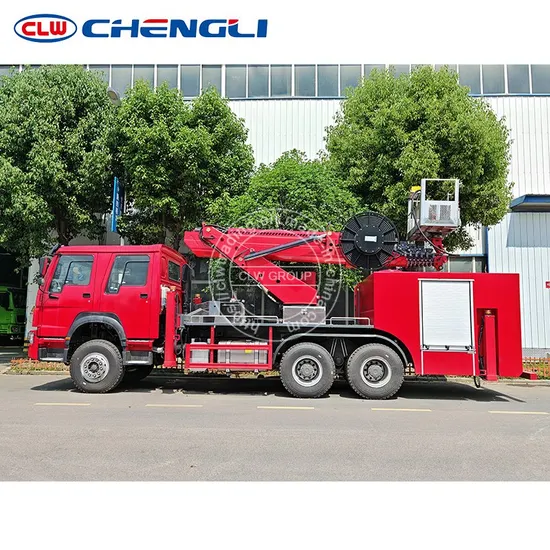
The HOWO 6×4 Aerial Platform Fire Truck is a Sinotruk HOWO 6×4 configuration with a boom-mounted work basket and enclosed side equipment compartments. It is presented as an aerial platform, not as a turntable ladder.
Use that page to begin a configuration enquiry, with the position and load schedule above. Working height, outreach, cage rating, support dimensions, tank capacity and price must be established for the offered configuration before it can be compared numerically with the examples in this guide. The 32 m figures and cage ratings above are not specifications for this HOWO vehicle.
For the broader equipment range, see Rescue Fire Trucks. Compare ground-rescue and incident-support duties separately from aerial access.
Vehicles discussed in this guide